
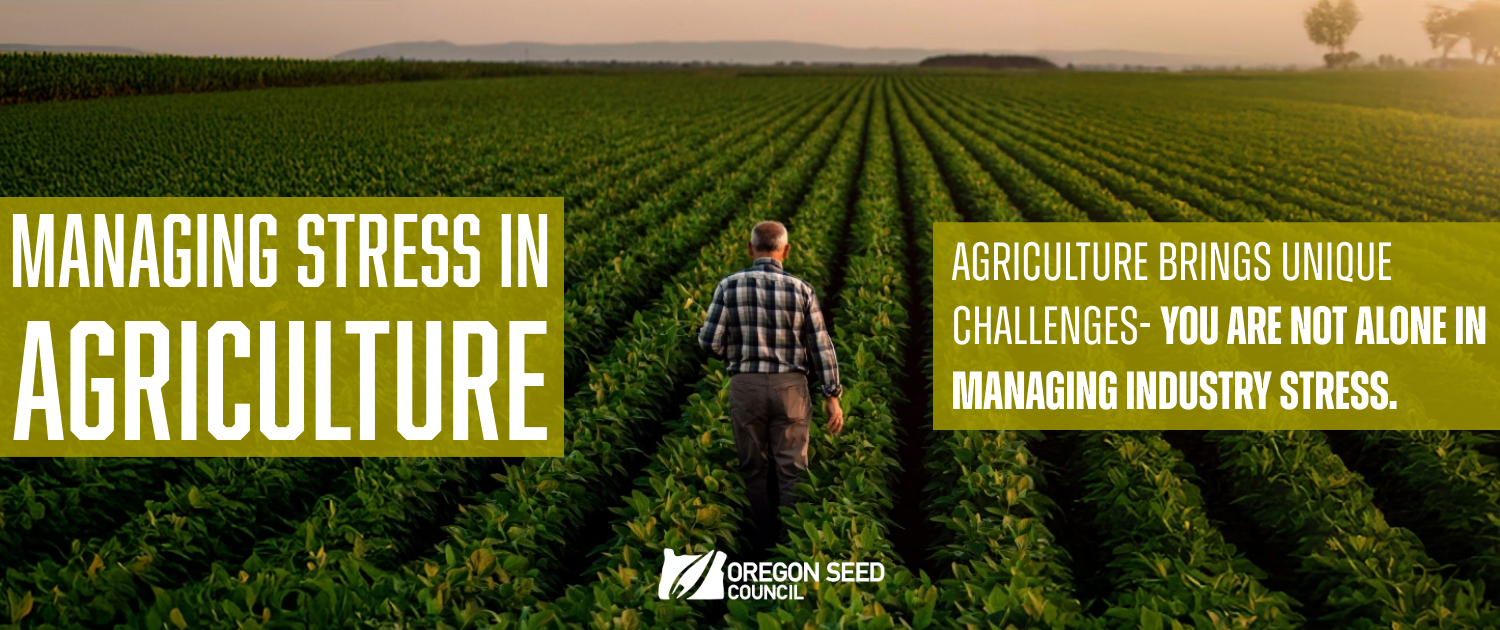
Mental Health Concerns on the Rise in Stressful Times
With seed prices depressed and seed contracts hard to come by, many grass seed farmers are feeling stressed. It’s a condition that, according to Oregon State University Extension faculty, is not unusual in the high-stakes world of farming, but a condition that merits attention, nonetheless.
Farmers in general face unique stressors, according to Extension faculty. Unlike most professionals, farmers can’t easily relocate to a new city or change jobs. And farming is often a lifestyle passed down from generation to generation. Because of these and other factors, pressures inherent in the threat of a farm business failure can be overwhelming.
“If the farm fails, it can be one’s place of living. It involves family. It’s a lifestyle. All of that changes,” said Teagan Moran, small farms coordinator for Linn, Benton and Lane counties. “So, it can be very different from somebody who loses a job or fails at another business.
“Farming is isolating, it’s high stress with high stakes,” she said.
Moran in recent years has been part of an effort by some Extension faculty to address mental health issues in the farming community. Moran frequently brings up the topic at field days and in grower meetings to try get growers to open up and talk about stress. And she at times will probe farmers for information if she senses they are stressed.
The effort is important, she said, because stress isn’t a topic farmers like to address. OSU Extension field crops agronomist Christy Tanner, agrees.
“I think part of the problem is that this is something that people tend to keep under wraps,” Tanner said. “It’s not something that people are all that comfortable talking about, and so the danger is that it is going on, and we don’t see it. And that means that as a community, it’s harder to do something about it.”
Tanner, along with other Extension faculty, have participated in training that helps them notice symptoms of mental health issues. Called QPR for Question, Persuade and Refer, the training is open to the public. (See information on QPR as well as other resources in an accompanying story.)
At times, stress can lead to suicide, an outcome that unfortunately occurs far too often in the farming community. Nationally, farming ranks as one of the highest professions for suicide, with farmers committing suicide at a rate 3.5 times higher than the general population, according to figures from the Center for Disease Control and Prevention.
And stress can lead to farm accidents as decision-making becomes compromised, according to Moran.
“Decision-making directly correlates to risks on a farm,” Moran said. “Farming involves working with implements and tools that can cause significant injury. And so, this is a job that requires very clear-headed presence, and we as humans can’t do that when we are under a lot of stress, when we’re navigating mental health issues.”
Also, Moran said, at times farmers become so accustomed to stress they don’t realize the pressure they are under. “When you are operating in a high-stress environment, being highly stressed can just feel normal,” Moran said. This too can be a dangerous condition and lead to poor decisions, both in a business and in day-to-day operations.
Moran and Tanner encourage farmers to find resources for addressing farm stress and to be open to discussing the issue if not publicly, then at least privately through hotlines that are available to call 24/7 or through other resources.
Farmers who are supported in their mental health are better equipped to make sound decisions, adapt to change and maintain productive farms, Moran said. “When farmers struggle mentally, their families and communities feel the ripple effects both emotionally and economically,” she said.
Mental Health Resources for Farmers
Multiple mental health resources are available through OSU Extension for farmers and ranchers, including:
- OSU Extension Farm and Ranch Stress Assistance Network: https://extension.oregonstate.edu/farm-ranch-stress-assistance-network
- Agristress Hotline and Toolbox of Resources: https://extension.oregonstate.edu/agristress-helpline-oregon
- Climate Stress and Grief – Farmer Resilience: https://extension.oregonstate.edu/climate-stress-grief-building-resilience-farmers-ranchers
- Oregon State University College of Health Program: https://health.oregonstate.edu/extension/fch/coast-to-forest
- For the Love of Farming Podcast, where farmers share their strategies addressing mental health among other topics: https://extension.oregonstate.edu/podcast/love-farming
The following links are to training that Extension faculty are getting and/or offering as trainings to better serve farmers. Feel free to reach out to Extension faculty Teagan Moran if interested.
- QPR Training: https://qprinstitute.com/
- Mental Health First Aid: https://www.mentalhealthfirstaid.org/
Farmers and ranchers can also access the AgriStress Helpline, sponsored by the USDA, at 833-897-2474. It is available 24/7 to call or text.
Contributed by: Mitch Lies | Oregon Seed Council Journalist
Tags: Oregon Grass Seed, oregon seed council, Stress Management