The Oregon Seed Council successfully participated in the 2025 Oregon China Council Trade Mission to China October 28-November 12.
First and foremost, we want to recognize and say a huge thank you to our donors that made this trade mission possible:
- Former Senator Mae Yih
- Oregon Ryegrass Commission
- Oregon Tall Fescue Commission
- Oregon Fine Fescue Commission
- Oregon Clover Commission
- Oregon Seed Growers League
- Oregon Seed Association
- Dave and Lisa Goracke
- Terry Plagmann
- Emily Woodcock
- Orin Nusbaum
With the support of these organizations and individuals, OSC was able to send OSC President Dave Goracke, Oregon State University Associate Professor of Practice and OSC Board Member Dr. Christy Tanner, and myself on the trade mission. We are so grateful to have had diverse industry perspectives throughout the trade mission. This enabled the seed industry to bounce ideas off one another, observe opportunity through different perspectives, and add unique commentary to each conversation.
TRADE MISSION OVERVIEW
Because agriculture is a major import for China, and due to the fact that China has a longstanding partnership with the Oregon seed industry, the Oregon Seed Council held the industry spotlight throughout the trade mission.
The trade mission followed a multi-week expedition led by Senate President Rob Wagner, where state legislators and Oregon China Council (OCC) members teed up meetings and conversations with government officials.
Their work opened the door for our organization and OCC to engage in friendship and trade discussions.
Our portion of the trade mission included a number of meetings blending both government and business officials in partnership conversations. The two trade missions did not necessarily follow the same meeting path but had some intersection in regions visited.
Primarily, the government official section before us recognized the Oregon China Sister State Committee’s work to create sister cities and build friendship and partnership with the Tianjin Municipality and Fujian Province in China.
Our mission visited Inner Mongolia, Beijing, Shanghai, and Guangxi.
Not a minute was lost in our work. We were scheduled from morning to evening for the 16-day trade mission, and while not all activities will be referenced in this article, we will highlight some of the most significant visits and takeaways from the trade mission.
INNER MONGOLIA – HOHHOT
Our first destination was Inner Mongolia. The delegation started in Hohhot, the Capital of the province of Inner Mongolia.
This was the most extensive agricultural leg of the trade mission, where the delegation visited a seed research facility, multiple dairies, the Inner Mongolia Agriculture University, met with government officials multiple times, including for a hay deal signing, and OSC presented before a large room of business leaders and government officials in Inner Mongolia.
M-Grass was one of the first stops, and this business is the national seed research center for China, specializing in ecological restoration, forage, and turfgrasses. Inner Mongolia’s northern border is a desert climate and their work supports application of seed for reclamation projects, including reversing desertification – which is a major issue for the area.
The facility houses a large catalog of seed and soil samples with over 1 million soil samples collected and housed on site and significant numbers of viewable seed catalogues. M-Grass focuses on projects solely within China’s borders.
While we were at the facility, we asked about the largest pest issue, and the team said mice is the number one issue for the industry. This might be a research partnership opportunity as we assess how to address our vole issue.
We visited two dairies in the first couple of days of the trade mission: 1. Mengui, which is China’s number one dairy and number three business in the nation. 2. Yili is the second ranked dairy in the nation and notably has 1,000 product lines.
Dairy has not been a significant staple in the Chinese diet, but this is now rapidly changing with the next generations. Generally, both dairies supply products across China focusing on feeding the 1.4 billion population, with some international impact through the FIFA World Cup and the Olympics.
Both dairies have seen exponential growth over the last few years, and notably, are heavily invested in by the government.
We were able to see some notes on blends for feed, and primarily, it looks like Alfalfa Hay is the number one product in feed, OSC engaged in conversations with dairy officials for these two companies on potential for blend of tall fescue, more ryegrass, clover, and potential for other forage in animal feed.
At the Inner Mongolia Agriculture University, we saw a significant collection of seed and plant samples. The university has a grassland focused program, and heavy overlap with Oregon’s commodities, including sugarbeets, dairy, and animal husbandry.
The University does exchanges with other universities, and we see potential opportunities for exchanges between OSU and the Inner Mongolia Agriculture University, where research could be shared to help both us and Chinese partners understand soil and climate needs, allowing us to best recommend Oregon seed for the region.
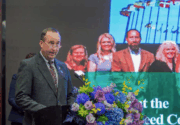
Early on the trade mission, OSC was asked to present as one of six businesses at a trade promotional forum. The forum included around 50 business and governmental leaders in addition to our Oregon delegation.
OSC provided information on:
- Who we are and our members
- Oregon seed products
- The importance of relationships with China
- Oregon’s exceptional quality
- Research
- OSU certification, and
- Our desire to learn more about China’s needs and build partnerships.
We also highlighted the benefits of various Oregon seed crops.
Our delegation members noted to us on this and other occasions how well OSC was perceived and presented our industry.
For this meeting, both Dave and I presented, and called out Christy as our research expert for participants to visit with after the presentation. This gave us a significant opportunity to build contacts.
Starting in Inner Mongolia, we had robust meetings and meals with government officials. Primarily, we met with officials from the Foreign Affairs Office of the People’s Government – but also leaders in economic development, education, commerce and other areas of interest to our industry.
Of note, by the end of the trade mission – both our leaders and our host government officials spoke highly and advocated for Oregon’s seed industry.
Relationships are key. Before we left for China, tariffs and international relations with China were rocky. The importance of relationships was demonstrated during a meeting between Oregon State Representative Mark Owens with Dai Qin – Vice Chairman of the People’s Government of Inner Mongolia Autonomous Region. During this and many future meetings during the trip, the meeting between President Trump and President Xi Jinping in South Korea was referenced. That engagement between the two countries’ leaders was significant for all of our meetings, as were the meetings held by Oregon Senate President Wagner and other members of Oregon’s delegation prior to our arrival in China.
Government to government relations are critical, so having our legislative leaders – Oregon State Representative Mark Owens and Senator Lew Frederick participate with us – set the Oregon Seed Council and seed industry up for success for international business relationships.
INNER MONGOLIA – ORDOS
Ordos presented several opportunities for us. Cashmere is a booming industry in Ordos. We visited photovoltaic locations – which have a significant impact in the area. We also visited an animal husbandry tech park where we were able to learn more about feed and opportunities to connect and discuss blend options. We also were able to connect with business and government leaders at each stop.
Erdos Cashmere (a large cashmere producer in Ordos) was a great contact for OSC. We learned there are 200 different grass varieties used to feed their 800 goats and all OSC team members were able to connect with the general manager regarding Oregon seed use in feed blends.
Across Inner Mongolia, we saw significant investment in renewable energy, including through wind and solar. Some of the items we saw that may be of interest to our industry include automation and autonomous EV technology. We saw electric vehicle development where vehicles could come to a power exchange to fully replace batteries to move agricultural products.
Generally, there was a significant focus on automation in all things, including in manufacturing lines.
Along with the Oregon delegates, government officials joined us at each tour stop. We were able to visit with the Ordos Vice Mayor and engage with staff, building cultural understanding and relationships.
BEIJING
Beijing, the Capital, provided OSC an opportunity to share high level messages about the seed industry with key leaders.
Dave and I visited the U.S. Embassy and spoke with Deputy Chief Mission (DCM) Gregory May, U.S. Embassy, China (second to the U.S. ambassador), and representatives of Agricultural Trade Office, Foreign Agricultural Services, APHIS, and other USDA staff about the seed industry, potential for partnership, interest in helping build markets for tall fescue, ryegrass, clover, and other forage with the dairies, and spoke with the APHIS leads on the anguina testing issue in annual ryegrass.
From there, OSC was connected with ASTA’s contact in China to navigate regulatory issues.
The staff helped the delegation members navigate some complexities in international affairs with China and understand how various national level engagements are impacting trade.
While not a direct connection for our industry, we were delighted to have an opportunity to share with the China National Food Industry how cover crops are utilized in the U.S. and what Oregon products can do for Chinese producers. Throughout the trade mission, we recognized cover crops were not being used in China. We think there are significant opportunities with the members of the China National Food Industry to educate growers on how to enhance production in China.
During our visit with officials from the Ministry of Commerce, OSC was able to provide a short presentation on the seed industry and opportunities across China, including for erosion control, preventing desertification, beautification in the larger cities, cover crops, and for other agricultural seeds. Christy was able to highlight seed certification and quality standards and the benefits of Oregon grass seed.
We worked closely with Representative Mark Owens to help tee up questions and point the conversation to OSC and our member crops.
SHANGHAI
Shanghai’s primary focus was the China International Import Expo. While we had a shared booth with WUSATA, our space was small and tucked away. We found it to be most useful to take the opportunity to meet with officials on-site. We did receive a number of contacts by leaving our business cards at the booth and mingling with participants. We have significant follow up to do!
During the Expo, Megan was able to meet with the in China ASTA rep to discuss the anguina issue. During the meeting the rep, who is a Chinese national, was highly impressed with our meeting itinerary and wanted to know how we were able to schedule the high-level meetings we had.
Dave was able to meet with the U.S. Deputy Consul General of Shanghai – Navarro Moore to talk through the angina issue and promote Oregon seed.
We also met with the delegation of the Nike Beijing partners and highlighted a need to have support in promoting natural turf for safety of athletes.
GUANGXI
Guangxi is primarily looking for a partnership for tourism. It’s a tropical region and has limited opportunities for the seed industry due to climate. However, a big takeaway from our visit to Guangxi was our visit with the Guangxi Normal University.
While they are focused on bringing in international students, and seeing partnership with universities, we found an opportunity for OSU at this forum. The University staff, who focuses on the life science program, is interested in bringing in grass, agriculture, and husbandry, particularly an education exchange to support habitat restoration.
During this meeting, OSC highlighted the Oregon-China partnership and our appreciation of China as a lead trade partner; quality and purity; and desire to collaborate.
While in Guangxi, we did see some interesting innovation, including through the Beibu Gulf Port, where the operations have heavily shifted to automated. There are self driving trucks, automated cranes, and a production line that is moving products with very little need for employees.
Finally, in Guangxi, the delegation met with H.E. Chen Gang – Secretary of the CPC Guangxi Committee along with a number of key government officials, including education, transportation, economic development, commerce, and others.
A Memorandum of Understanding was signed to recognize the friendship between Oregon and the province. This was again a valuable meeting because we were able to meet with officials and build relationships.
TAKEAWAYS/OPPORTUNITIES
- Relationships matter
- The experience was one-of-a-kind and the Oregon China Council was instrumental in its success
- Bringing diverse industry perspectives is critical
- China’s market has vast potential for the Oregon seed industry
- Education on cover crops would help Chinese partners
- Research on benefits of Oregon seed in forage blends needs to be shared to support the livestock industry
- Erosion control is a high need as crops are planted across slopes
- Inner Mongolia has significant need for support in preventing desertification
- There are plenty of opportunities for beautification projects
Megan Chuinard
Executive Director
Oregon Seed Council